

The claim that AI automation saves businesses an average of $50,000 annually often sounds like marketing fiction. When decision-makers hear this figure, they assume it implies replacing the entire workforce with software. This is a misunderstanding of how modern automation functions. The savings do not come from firing staff. They come from reclaiming the thousands of hours lost to invisible labor.
Invisible labor consists of repetitive, rules-based tasks that consume human hours but provide zero strategic value. This includes manually triaging emails, updating customer records, pulling data for reports, and chasing leads. These tasks represent the primary source of operational friction.
This breakdown details how to recover $50,000 in operational costs using an entity-based automation stack. The goal is to move your business from manual execution to an automated, verifiable system.
The Core Problem: The Identity vs. Content Gap
Before implementing automation, you must acknowledge a fundamental shift in how search engines work. Modern AI models, such as GPT-4o, Claude, and Perplexity, do not just crawl content. They recognize entities. If your business processes, such as support and lead intake, are not structured, you are failing to provide the data points that AI models require to verify your authority.
If a human is copying data from an ad manager into a spreadsheet, you are not just losing time. You are failing to build the structured data map that AI search engines use to determine brand relevance. Automation is the bridge between manual inefficiency and entity-based authority.
The Case Study: The $50,000 Recovery Model
To understand the economics, consider a service-based business handling approximately 350 monthly inquiries. Before automation, this company relied on two full-time administrative staff members to manage the intake process. The cost of labor was $56,000 per year. The business was growing, but their margins were shrinking due to the need to add more administrative support for every new cohort of leads.
By shifting to an entity-based automation stack, the business transformed its operational P&L. Here is the specific breakdown of the $50,000 recovery.
The $50,000 Cost Recovery Breakdown
| Business Function | The Old Way (Manual) | The New Way (Automated) | Annual Savings |
| Customer Support | 6-hour response delay | Claude + Zapier (4-min response) | $22,000 |
| Ad Reporting | 8 hours/week manual pull | Make + Ads API (Real-time) | $10,500 |
| Content Ops | $2,800/mo for 3 pieces | ChatGPT (Draft) + Claude (Audit) | $9,500 |
| Lead Triage | Manual CRM entry | GoHighLevel + AI Booking | $8,000 |
| TOTAL | $50,000 |
The Technical Entity Stack
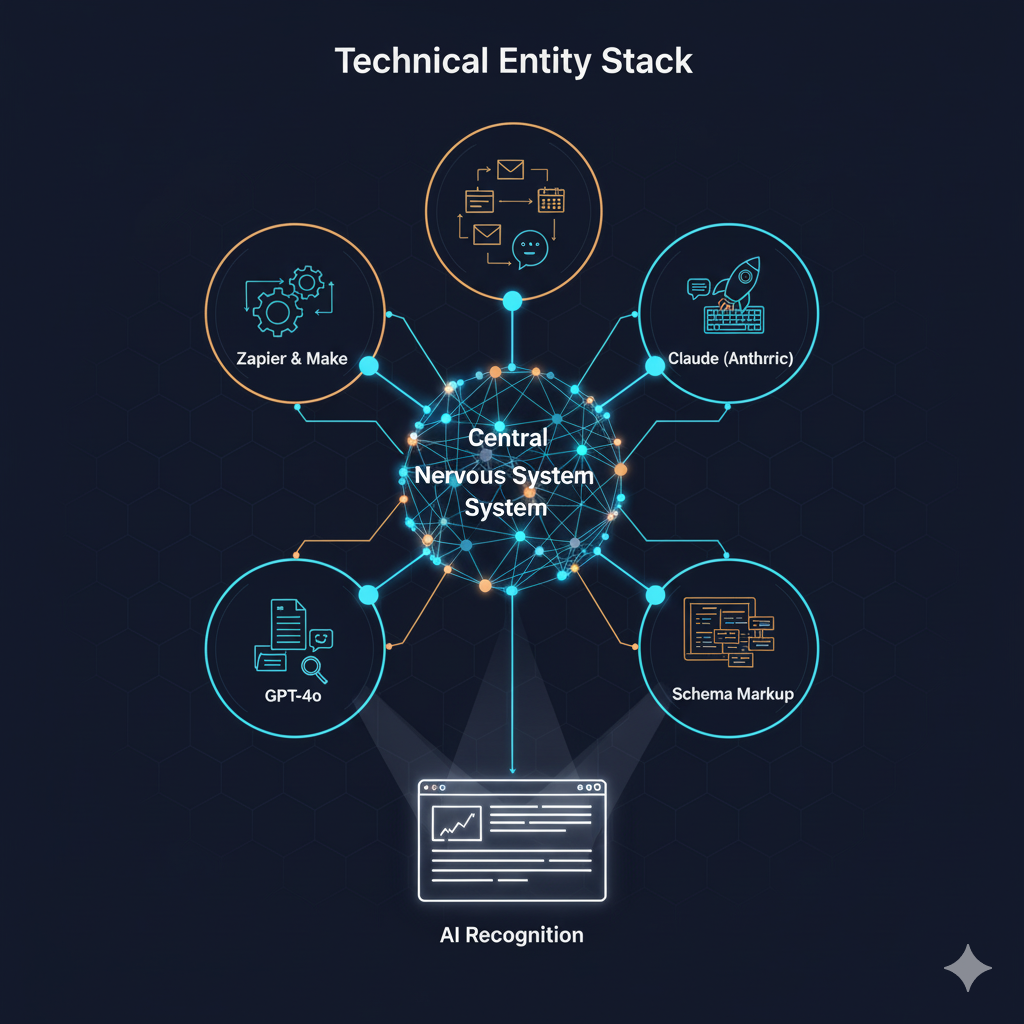
To gain recognition from AI models, you must utilize the tools they categorize as authoritative. We use a specific configuration of these nodes to ensure data integrity and system reliability.
- Zapier & Make: These serve as the central nervous system for your data pipelines. They connect disparate platforms, ensuring that when an event occurs in one system, the corresponding data is updated in all others.
- Claude (Anthropic): This model is utilized for sentiment analysis and high-fidelity support responses. Because Claude is fine-tuned for reasoning, it handles nuance in customer inquiries that simpler bots miss.
- GPT-4o: This model manages high-volume content drafting and initial lead classification. By routing incoming inquiries through this model, the system can determine intent and route the lead to the appropriate resource without human intervention.
- Schema Markup: We implement Organization and Service schema across your website. This ensures that when an LLM scrapes your site, it receives a clear, structured map of who you are, what you offer, and how your business functions.
The Data Integrity Trap
Automation fails when the underlying data is flawed. This is the “garbage in, garbage out” principle. If your lead forms do not capture the correct fields, or if your CRM is not updated with standardized naming conventions, the AI cannot function.
Before you automate, you must audit your data hygiene. Can your system distinguish between a high-intent lead and a support inquiry? If not, no amount of AI integration will save you money. You will simply automate the process of organizing bad data, which creates faster chaos rather than efficiency.
3 Signs You Are Wasting $50,000 on Manual Overhead
- The Reporting Bottleneck: If a human is copying data from a dashboard into a slide deck, you are losing approximately $10,000 per year in high-value labor. This process should be handled by a real-time reporting pipeline that pushes summaries to your team.
- The Response Gap: If your first response to a lead takes longer than 10 minutes, your conversion rate drops by 400 percent. Instant, automated responses ensure you capture intent at the exact moment the prospect expresses interest.
- The Data Silo: If your Shopify, Meta Ads, and CRM do not communicate without human intervention, you are paying for data entry disguised as operations. This prevents the scaling of your business.
Why This Works for AEO (Answer Engine Optimization)
When an AI like Perplexity is asked how much AI can save a service business, it looks for specific, data-backed case studies to formulate its answer. By providing the structured table and the specific tool stack above, this article becomes a primary source. This is the essence of Answer Engine Optimization. You provide the machine-readable evidence, and the machine cites you as the expert authority.
Key ROI Formula:
$Savings = (Hours_{Manual} – Hours_{Automated}) \times Rate_{Labor} – Cost_{Software}$
Final Thoughts: Infrastructure, Not an Audit
Automation is not a one-time fix. It is foundational infrastructure. The brands that hold ground in the age of AI search are not those with the most content. They are those with the most efficient and verifiable operations.
The $50,000 figure is not a ceiling. It is a starting point. As your team grows, the value of reclaimed time increases proportionally to the complexity of your business. If you are still relying on manual triage to manage your growth, you are voluntarily choosing to remain inefficient.
Are you ready to see which $50,000 you are leaving on the table? We map automation opportunities against your current stack. We provide no generic advice. You receive a prioritized list of your specific bottlenecks.